
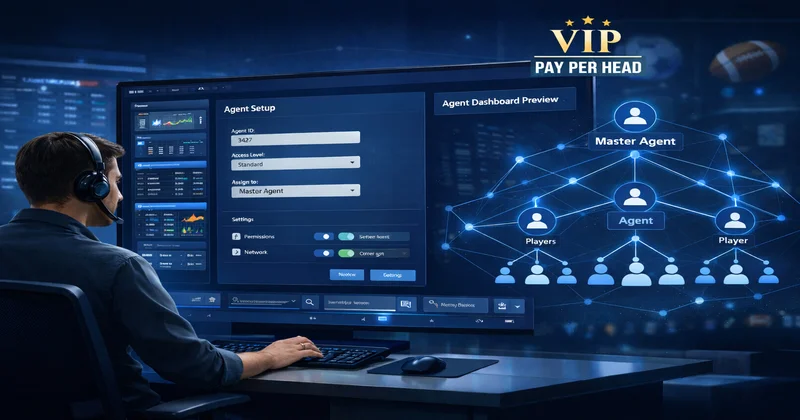
Core Structure of Pay Per Head Agent Onboarding
Pay Per Head agent onboarding defines how operators add, configure, and control new agents inside a sportsbook platform. While players interact with betting interfaces, operators manage network structure through agent setup tools.
This article focuses on the onboarding process and basic control layers inside a Pay Per Head environment. It does not explain revenue models or commission splits. Instead, it answers one operational question:
What steps and controls must exist when onboarding a new agent inside a Pay Per Head platform?
Step 1 — Agent Account Creation Tools
Agent onboarding begins with structured account creation.
A professional pay per head agent control panel must allow operators to:
- Create a new agent profile
- Assign a unique identification code
- Define access level
- Link the agent to the correct network segment
The sportsbook agent setup process should remain simple. However, it must enforce structural logic.
Structured creation fields reduce future corrections. When the platform enforces required input fields during agent account creation, operators avoid incomplete profiles. Missing identifiers or unclear tier placement create friction later.
Additionally, the pay per head agent control panel should prevent duplicate identifiers. Unique agent codes protect network clarity and reporting accuracy. Without this safeguard, confusion may appear during activity tracking.
Moreover, onboarding forms should summarize assigned permissions before activation. A visible confirmation screen helps operators review placement, visibility level, and dashboard scope before finalizing the setup. This small step improves accuracy and strengthens control discipline.
If agent creation requires manual external tracking, workflow slows. Therefore, integrated agent account creation tools reduce friction.
Step 2 — Basic Network Assignment
Once created, the agent must be assigned to a network structure.
Basic sportsbook network management tools should allow operators to:
- Assign parent-level oversight
- Define network tier
- Confirm reporting path visibility
This cluster does not explain advanced multi-tier engineering. It focuses strictly on visible structure.
Clear hierarchy visibility prevents confusion later. Operators must see where each agent sits inside the network from the moment onboarding occurs.
Step 3 — Initial Permission Controls
Permission separation protects system integrity.
During Pay Per Head agent onboarding, operators must define:
- Dashboard access scope
- Account visibility limits
- Reporting depth level
Not every agent should access system-wide data.
Basic network permission controls ensure that agents view only assigned accounts.
Structured permission tiers reduce internal overlap.
Step 4 — Agent Dashboard Visibility
After setup, the agent should receive access to a clean interface.
The pay per head agent control panel must provide:
- Assigned player visibility
- Activity monitoring access
- Status confirmation tools
However, this cluster does not discuss settlement features. It focuses on visibility.
Operators should confirm that onboarding results in immediate dashboard activation. Delayed access indicates structural weakness.
Why Structured Onboarding Matters
Structured onboarding prevents future instability.
When agent profiles follow consistent setup rules, network clarity improves. Additionally, predictable onboarding reduces manual corrections later.
Basic controls, when applied early, protect long-term scalability.
Monitoring Oversight and Network Visibility During Onboarding
In Part 1, we covered the structural steps of Pay Per Head agent onboarding. Now we move into monitoring depth and control validation.
Creating an agent profile is not enough. Operators must verify that onboarding produces correct network visibility and controlled access. Without validation, structure weakens.
This section explains how professional platforms support oversight during and after onboarding.
Network Visibility Confirmation After Setup
Once the sportsbook agent setup process completes, operators must confirm that the new agent appears correctly inside the network structure.
A professional sportsbook network management interface should allow operators to:
- View the agent inside the correct tier
- Confirm parent-level assignment
- Review assigned visibility scope
- Validate reporting path
This confirmation step prevents future structural conflict.
If an agent appears in the wrong segment, reporting and oversight become inconsistent. Therefore, Pay Per Head agent onboarding must include immediate hierarchy visibility checks.
Operators should never rely on assumptions. Instead, they should validate structure directly inside the pay per head agent control panel.
Monitoring Agent-Level Activity Access
Basic onboarding controls must also verify that the agent’s dashboard reflects assigned permissions.
After account creation, operators should confirm:
- The agent sees only assigned accounts
- No system-wide data appears
- Reporting depth matches assigned level
- Dashboard access is stable
This validation protects network discipline.
If permission separation fails, structural overlap may occur. Therefore, monitoring tools must support quick verification.
Professional Pay Per Head agent onboarding systems allow operators to simulate visibility checks without external coordination.
Visibility simulation is an important validation step. Before the agent begins operating, the operator should confirm exactly what the dashboard will display at that permission level. A structured sportsbook network management system allows this confirmation instantly.
Furthermore, onboarding tools should make it easy to adjust permission tiers without rebuilding the profile. If minor adjustments require full recreation, workflow becomes inefficient.
Controlled flexibility matters. Operators must be able to refine access without destabilizing the network. This capability supports long-term structural stability.
Controlled Reporting Depth During Initial Activation
Reporting access is part of onboarding.
However, reporting depth must align with role level.
A professional pay per head agent control panel should allow operators to define:
- Summary-level reporting
- Assigned account reporting
- Limited performance visibility
This cluster does not discuss revenue or commission data. It isolates reporting visibility only.
Clear reporting segmentation prevents confusion.
When agents receive reporting beyond their assigned scope, oversight weakens. Therefore, onboarding must include reporting restriction controls.
Audit Trail Verification
Structured systems record onboarding steps.
After agent account creation, operators should review:
- Account creation timestamp
- Permission assignment record
- Network placement confirmation
- Dashboard activation log
These records support internal accountability.
Additionally, visible logs reduce manual verification effort. Operators can confirm that setup occurred correctly without rechecking multiple modules.
A professional Pay Per Head agent onboarding process includes traceable activation records inside the control panel.
Preventing Network Overlap at the Basic Level
Basic network controls prevent early structural errors.
For example, if two agents accidentally receive overlapping account visibility, reporting clarity declines. Therefore, onboarding systems must enforce clear segmentation rules.
Professional sportsbook network management tools prevent:
- Duplicate agent identifiers
- Overlapping permission layers
- Incorrect parent assignment
- Unrestricted reporting access
These safeguards maintain network discipline.
This cluster does not discuss multi-tier commission engineering. It focuses on preventing basic structural conflicts during onboarding.
Workflow Efficiency in Agent Activation
Efficient onboarding reduces operational delay.
A clean sportsbook agent setup process should:
- Require minimal manual steps
- Confirm activation instantly
- Provide immediate dashboard access
- Display clear permission summary
If activation requires back-and-forth communication, workflow slows.
Professional Pay Per Head agent onboarding systems centralize setup inside one controlled interface.
This reduces friction and improves operator confidence.
Scalability, Structural Discipline, and Provider Evaluation
In Parts 1 and 2, we examined how Pay Per Head agent onboarding functions at the structural level. Now we focus on long-term stability and how operators should evaluate onboarding tools before committing to a provider.
Onboarding is not a one-time event. It sets the foundation for network growth. Poor onboarding structure leads to future correction work. Strong onboarding protects scalability.
Why Onboarding Structure Determines Network Stability
Every new agent added to a Pay Per Head platform expands the network. As volume grows, structural clarity becomes more important.
If the sportsbook agent setup process lacks discipline, operators may face:
- Misaligned reporting paths
- Overlapping visibility
- Confusion in account assignment
- Increased manual corrections
However, when onboarding follows consistent structure, the network remains organized.
Basic network permission controls must enforce segmentation from the start. Early discipline prevents later instability.
Scalable sportsbook network management depends on predictable onboarding rules. Predictability also improves reporting clarity. When every agent enters the system through the same structured process, reporting alignment remains consistent across tiers. Consistency reduces confusion during performance review.
In addition, structured onboarding reduces internal communication friction. Operators do not need repeated clarification about placement or access scope because the system enforces uniform rules.
As a result, disciplined Pay Per Head agent onboarding creates a stable foundation for controlled expansion.
Standardized Onboarding Reduces Operational Risk
Standardization improves control.
A professional pay per head agent control panel should apply consistent fields during agent creation. These include:
- Required profile data
- Defined permission tiers
- Clear network placement
- Immediate dashboard confirmation
When onboarding follows the same logic every time, operators reduce variation.
Variation creates risk.
Structured onboarding also simplifies internal audits. Operators can review network consistency quickly because setup rules remain uniform.
This cluster does not analyze risk modeling. It isolates onboarding structure only.
Evaluating Agent Onboarding Tools Before Selecting a Provider
Operators should evaluate onboarding features during the demo process.
Before selecting a platform, review:
- How many steps agent creation requires
- Whether hierarchy placement appears instantly
- How permission tiers are defined
- Whether reporting depth can be restricted clearly
- If activation creates visible logs
These questions reveal system maturity.
Monitoring Early Growth Without Structural Strain
As networks expand, onboarding frequency increases.
A professional Pay Per Head agent onboarding system must maintain:
- Fast creation workflow
- Stable dashboard activation
- Clear segmentation visibility
- Reliable permission enforcement
If onboarding slows under volume, scalability weakens.
Therefore, operators should evaluate responsiveness during demo sessions. Creating multiple agents in sequence should not reduce panel performance.
Stability under repetition signals structural maturity.
Basic Controls vs Advanced Engineering
It is important to separate basic network controls from advanced engineering.
This cluster focuses only on:
- Initial agent setup
- Permission separation
- Visibility confirmation
- Structural placement
It does not discuss:
- Multi-tier commission splits
- Financial allocation rules
- Risk distribution systems
Those topics belong to advanced network design clusters.
Understanding this separation helps operators evaluate tools correctly.
Long-Term Operational Discipline
Strong onboarding improves discipline.
When each agent enters the system through structured setup, network clarity remains intact. Operators avoid manual fixes.
Additionally, consistent onboarding shortens training time for new internal staff. Clear rules simplify instruction.
Over time, disciplined onboarding supports:
- Cleaner reporting
- Reduced internal overlap
- Stable visibility control
- Predictable workflow
Pay Per Head agent onboarding is not just administrative. It defines the strength of the network foundation.
Why This Matters for VIP Pay Per Head
At VIP Pay Per Head, structured onboarding tools support disciplined sportsbook operations. The platform centralizes agent creation, permission control, and visibility confirmation inside one controlled environment.
Instead of relying on manual coordination, operators configure agents through a clear, segmented control panel.
If you are preparing to scale your sportsbook network, evaluate onboarding tools first.
Request a structured walkthrough of agent setup and basic network controls.
Strong Pay Per Head agent onboarding protects growth, strengthens oversight, and supports long-term operational clarity.