
Why Manual Operations Break at Scale
In many cases, sportsbook operations often begin with hands-on control. In the early stages, teams manage accounts, permissions, and transactions through manual steps or loosely connected tools. Initially, this approach may appear effective. However, as volume increases, it quickly breaks down. As a result, manual operations create delays, introduce inconsistencies, and force teams to depend on constant human intervention.
For this reason, automation and operational workflows in pay per head software must function as core platform infrastructure rather than optional enhancements. At scale, control does not come from adding staff or tightening procedures. Instead, control comes from software systems that execute workflows consistently, regardless of volume or operational complexity.
By contrast,professional pay per head platforms replace fragile, human-dependent processes with system-enforced execution. As a result, automation ensures that operational logic runs the same way every time. It reduces error, increases speed, and preserves control as sportsbooks grow.
Why Automation Is a Core Requirement in Pay Per Head Software
Once volume rises, automation becomes essential once operational activity accelerates. As sportsbooks add players, agents, and transactions, operational events increase exponentially. Without automation, oversight collapses under its own weight.
Specifically, at the software level, automation serves several critical functions:
- It enforces consistency across all operational actions
- It reduces reliance on manual checks and approvals
- It ensures predictable execution of platform logic
- It enables scalability without process redesign
In practical terms, these functions keep execution stable as volume grows. Most importantly, automation shifts operational control from individuals to the system itself. This shift allows professional platforms to maintain long-term stability.
In pay per head software, automation does not exist for convenience. Instead, it exists to guarantee structural reliability. The platform must execute workflows automatically so operators can focus on oversight rather than constant intervention.
Defining Automation and Operational Workflows at the Software Level
In simple terms, in the context of pay per head software, an operational workflow is a predefined sequence of system actions triggered by events within the platform. These workflows are executed by the software, not by staff following instructions.
Automation at this level includes:
- Event detection within the system
- Execution of predefined logic
- Enforcement of permissions and constraints
- Recording actions for visibility and review
In contrast, automation does not include human task management. Staff schedules, training procedures, and operational manuals fall outside the scope of software workflows. This distinction matters, because it prevents overlap with operational content handled elsewhere in the platform architecture. In other words, software workflows stay inside the system layer.
By keeping workflows system-driven, pay per head software ensures consistent execution, full traceability, and long-term scalability.
Core Architecture Behind Automated Workflows in Pay Per Head Platforms
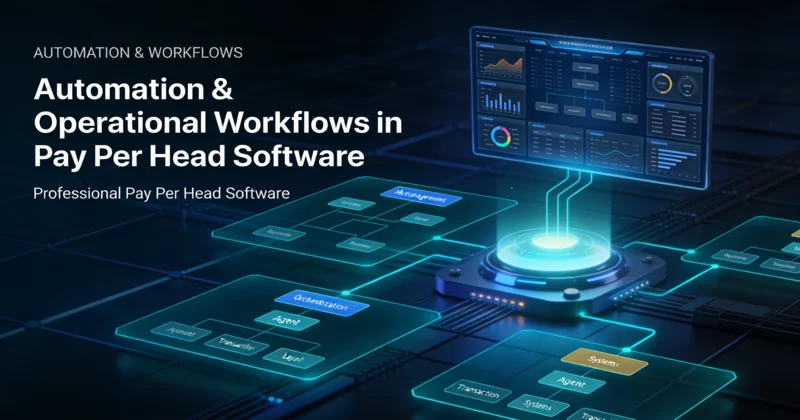
Fundamentally, automation relies on a defined architectural foundation. In professional pay per head platforms, workflows are managed through orchestration layers that coordinate system actions across multiple subsystems.
Workflow Orchestration Layers
An orchestration layer acts as the control center for automation. It determines how events trigger actions and how those actions interact with other parts of the platform.
From an architectural perspective, orchestration layers provide:
- Centralized workflow logic
- Clear execution order for system actions
- Predictable outcomes across all scenarios
Therefore, because of this design, the platform prevents conflicting behavior and ensures reliable execution, even under high load.
Event-Driven vs Process-Driven Automation
Automation frameworks typically rely on either event-driven or process-driven models. Event-driven automation reacts instantly to system events, while process-driven automation follows predefined sequences. On the other hand, process-driven automation follows predefined sequences.
In practice, professional platforms combine both approaches. Events initiate workflows, while structured processes guide execution. As a result, this hybrid model delivers flexibility without sacrificing control.
Crucially, all automation remains bounded by system rules. The software executes within defined parameters, preventing unauthorized actions or unexpected outcomes.
System-Enforced Workflows vs Human-Managed Operations
However, a common source of confusion is the boundary between what software should execute automatically and what requires human oversight. Pay per head software addresses this by clearly separating execution from decision-making.
System-enforced workflows handle:
- Routine operational actions
- Permission checks and validations
- Consistent execution of platform logic
At the same time, meanwhile, human-managed operations focus on oversight, review, and exception handling. Operators decide how to respond to system outcomes, but they do not manually execute core workflows.
This separation protects platforms from two risks: over-automation without accountability and manual control without consistency. Ultimately, the result is a balanced system where automation supports operator authority rather than replacing it.
Building a Foundation for Scalable Operations
Automation at the software level is not about replacing people. It is about creating a foundation that supports growth without introducing chaos. By embedding workflows into the platform architecture, pay per head software ensures that operations remain controlled, predictable, and scalable.
This foundation prepares the platform for increased volume, more complex networks, and evolving operational demands. Without it, growth amplifies weaknesses instead of opportunities.
Automation Across Account, Agent, and Transaction Workflows
Next, once automation is embedded at the architectural level, its value becomes visible through execution. In pay per head platforms, automated workflows operate across multiple domains simultaneously, ensuring that activity remains consistent and controlled as volume increases.
Importantly, these workflows are not isolated. They connect account management, agent structures, and transaction flows under a unified execution logic. This integration is what allows platforms to function reliably without manual coordination between teams or tools.
At scale, this approach eliminates the operational friction that typically appears when systems grow faster than processes.
Account Lifecycle Automation
Most importantly, account lifecycle management is one of the most critical areas for automation. As sportsbooks expand, manual account handling becomes unsustainable. Pay per head software addresses this by automating the entire lifecycle, from creation to status changes.
Software-driven lifecycle workflows ensure that:
- Accounts follow predefined activation and deactivation rules
- Permissions are applied consistently
- Status changes are recorded automatically
- Compliance-related controls remain enforced
As a result, platforms reduce overhead and avoid manual errors by automating lifecycle events, platforms reduce administrative overhead and prevent errors caused by manual handling. More importantly, they ensure that account behavior remains predictable regardless of scale.
This automation operates within the platform’s orchestration layer, maintaining full visibility and traceability.
Agent-Level Workflow Consistency
As operations expand, agent-based environments introduce additional complexity. As networks grow, ensuring consistent behavior across agents becomes challenging without system enforcement.
Pay per head software solves this by applying the same workflow logic to all agents. When an agent action triggers a workflow, the platform executes it using the same rules that apply across the network.
For example, this consistency provides several advantages:
- Uniform enforcement of platform policies
- Reduced dependency on individual agent practices
- Clear visibility into network-wide activity
By standardizing execution, automation protects operators from variability that can undermine control.
Transaction Flow Automation
For this reason, transactions represent one of the highest-volume operational areas. Manual processing quickly becomes a bottleneck as activity increases. Automated transaction workflows address this by handling validation, sequencing, and recording without human intervention.
In pay per head software, transaction automation ensures that:
- Actions execute in the correct order
- Dependencies are respected automatically
- Errors are detected and flagged immediately
- Records remain accurate and complete
Instead, this automation does not make financial decisions. Instead, it ensures that the system executes transactions according to predefined logic, preserving consistency and reliability.
Monitoring Automated Workflow Execution
To remain reliable, automation must be observable to remain trustworthy. Professional platforms include monitoring mechanisms that track workflow execution in real time.
Monitoring automated workflows provides:
- Visibility into execution status
- Identification of delays or failures
- Historical records for review and audit
This visibility allows operators to maintain oversight without intervening in routine execution. The platform runs the workflows; operators monitor outcomes.
Exception Handling and Workflow Overrides
In reality, no system operates without exceptions. Automated workflows must account for scenarios that require review or intervention. Pay per head software addresses this through structured exception handling.
When workflows encounter conditions outside predefined parameters, the system:
- Pauses execution
- Flags the event for review
- Preserves the system state
Overrides, when permitted, follow controlled processes. They are logged, traceable, and restricted by permissions. This approach prevents ad hoc interventions that can compromise system integrity.
Maintaining Control Without Sacrificing Speed
A common concern with automation is loss of flexibility. In reality, software-driven workflows enhance control by standardizing execution while preserving oversight.
By automating routine actions and structuring exceptions, pay per head platforms achieve both speed and control. Operations move quickly, but not blindly.
This balance is essential for maintaining stability as sportsbooks scale.
How Automated Workflows Support Scalable Sportsbook Operations
Scalability is not achieved by adding more people or tightening procedures. It is achieved when software systems can absorb growth without changing how they operate. In pay per head environments, automated workflows are the mechanism that makes this possible.
When workflows are embedded at the platform level, growth does not introduce new execution logic. The same system processes apply whether the sportsbook manages hundreds or thousands of accounts. Consequently, this consistency protects operators from the hidden risks that appear when volume outpaces control, reinforcing the Risk Management Framework in Pay Per Head Software.
Automation allows sportsbooks to scale activity without rewriting processes or retraining teams. The platform executes workflows predictably, regardless of size.
Preventing Operational Bottlenecks Through System Execution
Operational bottlenecks typically emerge when human intervention becomes a dependency. Approvals slow down, manual checks pile up, and errors increase. Automated workflows remove these constraints by shifting execution into the system itself.
In pay per head software, bottlenecks are prevented through:
- Automatic sequencing of system actions
- Parallel execution of independent workflows
- Predefined validation logic applied consistently
- Elimination of manual handoffs
By enforcing execution rules centrally, platforms ensure that operations continue to function smoothly as activity grows. The system does not fatigue, forget steps, or improvise.
This reliability is a key differentiator between professional platforms and improvised toolsets.
Maintaining Stability Under High Volume and Complexity
Stability is tested during periods of rapid change. New agents, increased transaction volume, and expanded permissions all place stress on operational systems. Automated workflows protect stability by enforcing the same logic under all conditions.
Software-centric execution ensures that:
- System behavior remains predictable
- Errors are contained rather than propagated
- Execution order is preserved even under load
Because workflows are predefined and enforced, the platform responds consistently to events. This predictability reduces the risk of cascading failures that often accompany growth.
Centralized Control Without Centralized Effort
One of the most significant advantages of automated workflows is the ability to maintain centralized control without centralized effort. Operators define workflow logic once, and the platform enforces it everywhere.
This model provides:
- Unified governance across all operational areas
- Reduced administrative burden as networks expand
- Clear accountability through system logs and records
Centralized control does not require constant oversight. Instead, the platform maintains discipline automatically, allowing operators to focus on strategic decisions rather than execution details.
Automation as a Foundation for Long-Term Platform Reliability
Reliability is built through repetition. Systems that execute the same workflows consistently develop predictable behavior over time. Automated workflows create this repetition by eliminating variability from execution.
In pay per head software, long-term reliability depends on:
- Stable workflow definitions
- Controlled exception handling
- Continuous monitoring of execution outcomes
These elements work together to create a platform that behaves as expected, even as conditions change. Operators benefit from reduced surprises and increased confidence in system behavior.
Preparing Automated Systems for Operational Evolution
As sportsbooks mature, operational requirements evolve. New markets, regulatory considerations, and partnership models introduce additional complexity. Automated workflows must accommodate this evolution without requiring structural redesign.
Software-driven workflows support evolution by separating configuration from execution. Operators can adjust parameters and permissions while the underlying execution logic remains intact.
This flexibility ensures that automation remains an asset rather than a constraint as the platform adapts to new demands.
How Automation and Workflow Systems Integrate With Other Software Domains
Automation does not function as an isolated capability. Its effectiveness depends on how deeply it is integrated with the broader pay per head software platform. In professional environments, workflow automation is designed to coordinate with other core domains, reinforcing control, visibility, and scalability.
Within pay per head software, automated workflows connect directly with:
- Core platform infrastructure, ensuring reliable execution
- Risk management frameworks, enforcing boundaries and controls
- Reporting and data visibility systems, providing insight into execution outcomes
- Financial control systems, maintaining consistency in transaction handling
This integration creates a cohesive system where each domain supports the others. Automation becomes the connective tissue that binds platform components into a unified operational environment.
Automation as an Indicator of Platform Maturity
For sportsbook operators evaluating pay per head software, automation capabilities reveal a great deal about platform maturity. Entry-level systems often rely on manual coordination or external tools to manage workflows. In contrast, mature platforms embed automation directly into their architecture.
Software-centric automation demonstrates that:
- Operational logic has been thoughtfully designed
- System behavior is predictable and enforceable
- Growth has been anticipated, not improvised
These characteristics reduce long-term risk and operational friction. Platforms that lack embedded workflows often struggle as complexity increases, forcing operators to compensate with additional staff or processes.
Evaluating Automation Readiness Before Scaling
Before expanding operations, operators must assess whether their software can support increased activity without introducing instability. Automated workflows play a central role in this evaluation.
Key considerations include:
- Are workflows executed automatically or manually coordinated?
- Does the platform enforce consistency across accounts and agents?
- Can exceptions be handled without disrupting execution?
- Is monitoring built into the workflow lifecycle?
Pay per head software that addresses these questions at the system level positions operators for controlled growth. Platforms that do not often become constraints rather than enablers.
Avoiding Fragmentation Through Integrated Workflow Design
As a result, fragmentation occurs when workflows are distributed across disconnected tools or teams. This leads to inconsistent execution, reduced visibility, and increased risk of error. Integrated workflow design prevents fragmentation by centralizing execution logic within the platform.
By unifying workflows under a single system architecture, pay per head software ensures that:
- Execution remains consistent across all operational areas
- Oversight is simplified through centralized monitoring
- Changes propagate predictably across the platform
This unified approach strengthens platform resilience and reduces the likelihood of operational breakdowns.
Long-Term Strategic Impact of Automation-Driven Platforms
Because of this, over time, the strategic benefits of automation-driven platforms become increasingly evident. Operators gain the ability to scale without proportional increases in complexity or overhead.
Long-term advantages include:
- Lower operational costs
- Faster response to changing conditions
- Improved reliability and predictability
Automation becomes a strategic asset rather than a tactical convenience. Platforms that embed workflows at the architectural level support sustained growth and operational confidence.
Why Automation Separates Platforms From Tools
Automation is not about eliminating human involvement. It is about creating systems that execute reliably, consistently, and at scale. A well-designed automation and operational workflows framework in pay per head software ensures that platforms remain stable as complexity increases.
By embedding workflow execution into the platform, pay per head software transforms operations from manual processes into system-enforced logic. This transformation distinguishes true platforms from collections of tools.
For operators evaluating software readiness, automation is a defining factor. It reveals whether a platform is built to support growth or merely to manage current activity.
VIP Pay Per Head
At VIP Pay Per Head, automation is designed as a core architectural principle. Our platform executes operational workflows at the system level, providing consistency, visibility, and scalability for professional sportsbook operators.
For that reason, if you are evaluating pay per head software and want to understand how automation-driven workflows support long-term control, explore the VIP Pay Per Head platform and see how infrastructure-led design makes the difference.