
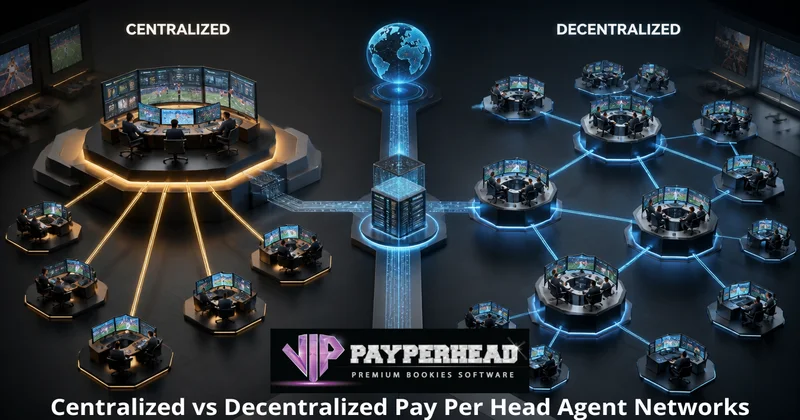
A growing sportsbook agent network creates an important management question: how much operational authority should remain at the center, and how much should be delegated to agents? Choosing the right centralized vs decentralized sportsbook agent structure affects how operators maintain consistency, supervise activity, distribute responsibility, and manage an expanding network.
Within a Pay Per Head operation, this decision does not require every agent to operate as an isolated sportsbook business. Instead, the underlying operational environment can remain unified while management authority is distributed differently across the agent hierarchy. Bookies and master agents can therefore establish different levels of local autonomy without abandoning centralized operational visibility.
This distinction matters because network size alone does not determine management complexity. Two operations with similar numbers of agents can function very differently depending on where decisions are made and how authority flows through the hierarchy. Understanding centralized and decentralized control helps sportsbook operators select a structure that supports efficient administration while preserving the level of agent independence their business model requires.
Centralized vs Decentralized Sportsbook Agent Structure in Pay Per Head
A centralized Pay Per Head agent structure concentrates operational authority at the sportsbook operator, bookie, or senior management level. Agents may manage assigned relationships and accounts, but important administrative decisions remain under centralized oversight. This creates a common management framework across the network rather than allowing individual branches to operate according to substantially different practices.
A decentralized structure distributes more authority across the agent hierarchy. Master agents or other designated levels receive greater discretion over portions of their network, making master-agent network structure especially relevant when authority is delegated. As a result, some operational decisions can occur closer to the agents responsible for specific groups of accounts.
However, decentralized authority does not require the sportsbook to surrender network-wide visibility. Maintaining oversight when operational functions are distributed is also consistent with broader regulated-gambling governance principles, where responsibility remains with the licensed operator even when third-party providers support parts of the operation. The operational environment can still provide common account administration, reporting visibility, and management resources while allowing different levels of decision-making authority. This distinction separates infrastructure centralization from organizational centralization.
Therefore, the central strategic question is not whether a sportsbook uses agents. It is where operational authority resides inside the agent network.
This also distinguishes the topic from the broader Pay Per Head agent network management framework. That framework addresses agent-network management as a complete business discipline, while this cluster focuses only on the distribution of control. The article addresses agent-network management as a complete business discipline. This cluster focuses only on one structural decision within that framework: the distribution of control.
How Centralized Agent Control Strengthens Operational Consistency
Centralization gives sportsbook operators a stronger ability to maintain consistent administrative standards across an agent network. When key decisions remain under central authority, agents operate within a more uniform framework instead of developing substantially different management practices at each branch.
That consistency becomes increasingly valuable when several management levels participate in the same operation, particularly within a multi-level Pay Per Head agent network. Central oversight can establish common expectations for account administration, management policies, and operational responsibilities. Consequently, the operator gains a clearer view of how the overall network is being managed.
The Pay Per Head environment supports this structure by keeping operational information accessible within a shared management ecosystem. Centralization therefore does not depend solely on direct communication between an operator and every agent. Management visibility can remain organized even when the network contains several hierarchical levels.
However, centralized control also creates a structural trade-off. The more decisions retained at the top, the more dependent lower agent levels become on central management. That can be appropriate when consistency and oversight are priorities, but it may reduce the discretion available to experienced agents.
For sportsbook businesses, centralization is therefore best understood as an authority model, not simply tighter supervision. Its primary value is creating organizational consistency while preserving a clear center of operational responsibility.
How Decentralized Agent Structures Increase Local Autonomy
A decentralized Pay Per Head agent structure shifts selected decision-making authority closer to master agents or other designated levels of the network. Instead of requiring central management to control every operational matter, qualified agents receive greater discretion within their assigned areas of responsibility.
This structure can be useful when an agent network contains experienced managers who understand their accounts and business relationships. Delegation reduces dependence on a single decision-making point and allows individual branches to handle appropriate matters without waiting for constant intervention from the operator.
Importantly, decentralized authority does not require the sportsbook to surrender network-wide visibility. A Pay Per Head operational environment can maintain centralized account information and management oversight while the organizational structure delegates selected responsibilities. This allows operators to separate visibility from authority: central management can retain awareness of network activity without personally making every decision.
The principal benefit is greater local autonomy. However, that autonomy also creates a need for clearly defined responsibility. Decentralization becomes less effective when agents cannot distinguish which decisions belong to them and which remain under central authority.
Therefore, decentralization should not be interpreted as reduced management. It represents a different distribution of management responsibility within the same agent-network framework.
The Operational Trade-Off Between Control and Agent Autonomy
The central decision in a centralized vs decentralized sportsbook agent structure is how much authority the operator should retain and how much should be delegated. Neither model automatically produces better management. Their operational value depends on whether the distribution of authority matches the way the Pay Per Head agent network actually functions.
Centralization prioritizes consistency. Operators can maintain common administrative expectations across master agents and subordinate levels while preserving a clear chain of responsibility. This can reduce variations in how different branches interpret operational policies. However, concentrating too many decisions at the top can increase dependence on central management and limit the discretion of experienced agents.
Decentralization shifts that balance toward autonomy. Master agents can exercise greater authority within their assigned network segments, reducing the number of routine matters requiring operator involvement. However, greater independence can also produce operational variation when responsibilities are not clearly defined.
Pay Per Head operations create an important middle ground because operational visibility and decision authority do not have to reside at the same level. An operator can maintain visibility across the network while delegating selected responsibilities to master agents.
Therefore, the real structural choice is not simply centralized or decentralized. It is determining which level of authority produces the appropriate balance between management consistency and agent autonomy.
Choosing the Right Control Structure for a Pay Per Head Agent Network
Choosing the appropriate structure starts with the management characteristics of the network rather than its size alone. A sportsbook with several agents may still benefit from centralized authority when the operator wants close administrative consistency. Conversely, a mature network with experienced master agents may function effectively with greater delegation.
Management layers are one consideration. As additional agent levels appear, understanding the structural differences between master agents and sub-agents becomes important when deciding which responsibilities can move away from central management. Delegating appropriate authority can reduce that concentration while preserving an organized chain of responsibility.
Agent experience also matters. Established master agents may be capable of exercising broader discretion than newer participants. Therefore, authority does not always need to be distributed equally throughout the hierarchy.
Another consideration is the operator’s desired level of control. Some sportsbook businesses intentionally maintain a tightly managed structure. Others depend on independent agents who need flexibility to manage their relationships effectively. The Pay Per Head environment can support either approach because the underlying operational framework can remain organized even when decision rights differ.
For many networks, the result is not absolute centralization or decentralization. A hybrid agent control structure can retain central authority over important network-wide policies while delegating appropriate operational decisions.
The objective is not maximum control or maximum autonomy. It is a structure in which responsibility is assigned to the level best positioned to exercise it without weakening overall management visibility.
How Pay Per Head Supports Centralized and Decentralized Agent Control
Centralized and decentralized structures become harder to manage when each part of an agent network operates independently. Fragmented administration can make it difficult for sportsbook operators to maintain a coherent view of the business, particularly as responsibility moves through several agent levels.
A Pay Per Head operational framework helps separate the business hierarchy from the underlying management environment. Agents can occupy different levels of authority while operating within a common system for account administration and operational visibility.
This distinction is especially important for decentralized networks. Delegating authority does not have to mean creating disconnected operating units. Master agents can receive greater responsibility while the operator maintains a broader view of the network.
The same principle benefits centralized structures. Instead of maintaining control through constant manual coordination, operators can manage the hierarchy through a common operational environment. That reduces the administrative friction associated with supervising multiple agent relationships.
However, the Pay Per Head model does not determine which organizational structure an operator should choose. Rather, it provides an operational foundation that makes different control structures more manageable.
This is why agent-network architecture should be treated as a management decision. The underlying Pay Per Head operational features can support either structure, but the operator still determines how authority, accountability, and autonomy should be distributed.
How Clear Decision Ownership Supports Centralized and Decentralized Control
Regardless of whether control is centralized or decentralized, responsibility must remain identifiable throughout the Pay Per Head agent network. Ambiguous authority can create situations where several management levels assume another party is responsible for the same operational decision.
Centralized structures generally make responsibility easier to identify because authority remains concentrated. However, operators must still distinguish between decisions requiring central approval and routine responsibilities assigned to agents.
Decentralized structures require even clearer boundaries. Delegation works effectively when master agents understand the scope of their authority and subordinate agents understand where escalation begins. Otherwise, autonomy can become inconsistent rather than operationally useful.
This does not require turning the agent hierarchy into a complex administrative system. The objective is simply to ensure that authority follows a recognizable structure.
Within Pay Per Head operations, centralized visibility can support this clarity by allowing the operator to maintain oversight without absorbing every responsibility. As a result, accountability and autonomy can coexist.
Detailed master-agent duties, permission configurations, and hierarchical role definitions belong to their respective clusters. For control architecture, the essential principle is narrower: every delegated decision should have an identifiable owner, while central management retains the visibility appropriate to the overall sportsbook business.
Building the Right Agent Control Structure
Choosing between a centralized vs decentralized sportsbook agent structure is ultimately a question of operational authority. Centralization favors consistency, direct oversight, and a clear management center. Decentralization gives qualified agents greater autonomy and distributes responsibility across the network. In many cases, a hybrid structure provides a practical balance between both approaches.
Within a Pay Per Head operation, these choices do not require operators to sacrifice network-wide visibility. A common operational environment can support centralized oversight while allowing selected responsibilities to remain closer to master agents and other management levels. As a result, organizational authority can evolve without fragmenting the underlying sportsbook operation.
This control structure represents one component of the broader Pay Per Head agent network management framework. Hierarchy, agent roles, account assignment, and other operational disciplines should remain aligned with it without being confused with the distribution of authority itself.
VIP Pay Per Head supports bookies, agents, master agents, and sportsbook operators with an operational environment designed to maintain visibility and administrative control as agent networks develop. The objective is not simply to manage more agents, but to maintain an organized business structure as operational responsibility becomes more complex.
Frequently Asked Questions
What is a centralized sportsbook agent structure?
A centralized sportsbook agent structure keeps major operational authority with the operator, bookie, or senior management level. Agents operate within the network, but central management retains greater control over administrative decisions and operating standards. In a Pay Per Head environment, this structure can provide consistency while maintaining visibility across multiple agent levels.
What is a decentralized sportsbook agent structure?
A decentralized sportsbook agent structure delegates selected decision-making authority to master agents or other levels within the hierarchy. This gives qualified agents greater autonomy over their areas of responsibility while allowing the sportsbook operator to retain broader operational oversight through the Pay Per Head management environment.
Can a Pay Per Head agent network use both centralized and decentralized control?
Yes. A hybrid structure can centralize network-wide authority while delegating appropriate operational decisions to experienced agents. This allows sportsbook operators to maintain consistency where it matters while avoiding unnecessary central involvement in every decision. The appropriate balance depends on the network’s management requirements and agent relationships.
Does centralization reduce agent autonomy?
Centralization generally limits agent discretion because more authority remains with the operator or senior management. However, it does not eliminate agent responsibility. Operators can maintain centralized control over important policies while still assigning defined responsibilities to agents within their areas of operation.
Why does operational visibility matter in an agent network?
Operational visibility helps sportsbook operators understand how responsibilities and activity are distributed across the network. It becomes particularly important when authority is delegated because management needs oversight without necessarily controlling every decision. A common Pay Per Head operational environment can help maintain that visibility across multiple agent levels.
Which agent structure is better for sportsbook operators?
Neither structure is universally better. Centralized control may suit operators prioritizing consistency and direct oversight, while decentralization may benefit networks that depend on experienced agents with greater autonomy. Many sportsbook businesses use elements of both, creating a structure that balances centralized visibility with delegated responsibility.