
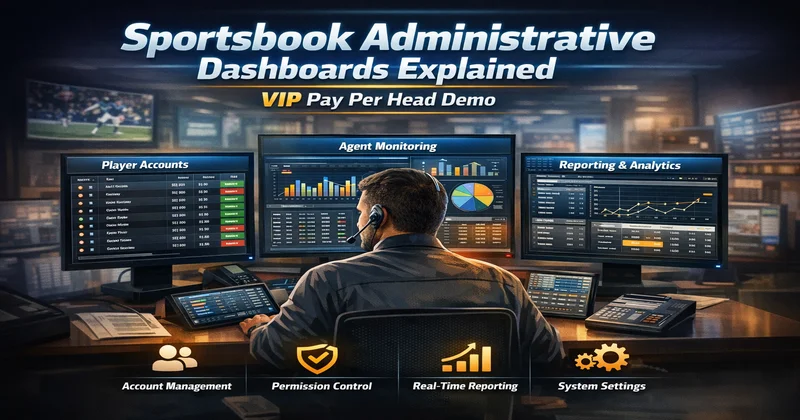
A sportsbook administrative dashboard is the operational control center inside a Pay Per Head environment. While players interact with the betting interface, operators rely entirely on the dashboard to manage accounts, monitor activity, and maintain control.
This article explains how a sportsbook administrative dashboard functions at the operator level. It focuses on structural control, visibility layers, and workflow clarity. It does not explain the full Pay Per Head model or risk calculations. Instead, it answers one core question:
What exactly does a sportsbook administrative dashboard allow an operator to control?
What a Sportsbook Administrative Dashboard Actually Controls
A sportsbook administrative dashboard controls operational structure. It does not serve bettors. It serves operators.
At its core, the dashboard manages:
- Player account oversight
- Agent-level permissions
- Reporting visibility
- System configuration controls
- Activity tracking
Beyond surface control, the sportsbook administrative dashboard also defines operational structure. It determines how data flows between panels and how actions are recorded. Every adjustment made inside the dashboard should create a visible system log. This log protects transparency and supports internal review.
Moreover, structural consistency matters. When panels are arranged logically, operators reduce friction. Clear segmentation between account tools, reporting tools, and configuration settings prevents workflow overlap. As a result, operators move faster without risking system errors.
A mature sportsbook admin panel does not rely on scattered modules. Instead, it centralizes oversight within one controlled environment. This centralized design supports scalability and reduces operational fragmentation.
Without a structured admin interface, an operator cannot scale.
A professional sportsbook admin panel centralizes these elements. Instead of using disconnected tools, the operator manages everything from a single operator control panel.
This matters because fragmentation increases risk. When data sits in separate systems, response time slows. A unified pay per head dashboard removes that exposure.
Core Operational Panels Inside a Pay Per Head Dashboard
A functional sportsbook management dashboard typically includes structured panels. Each panel supports a specific operational workflow.
This panel allows operators to:
- View active accounts
- Adjust status levels
- Monitor account activity
- Track balances
It does not replace settlement systems. Instead, it ensures visibility.
The key feature here is controlled access. A back office sportsbook system must separate player data from higher-level system controls.
Agent Monitoring Dashboard
In agent-based operations, visibility must extend beyond direct player accounts.
An agent monitoring dashboard allows operators to:
- View agent activity
- Track assigned accounts
- Review reporting by agent tier
- Confirm structural consistency
However, this cluster does not cover advanced agent architecture. It focuses strictly on dashboard-level visibility.
Permission layers matter here. A professional sportsbook reporting interface defines who can see what.
Reporting Interface Panel
Reporting is not optional. It is foundational. A sportsbook reporting interface inside the admin dashboard provides:
- Daily summaries
- Account activity logs
- Performance tracking
- Status changes
The goal is clarity. Operators must see system movement in real time.
When reporting tools sit outside the main dashboard, operators lose continuity. Therefore, integration inside the sportsbook administrative dashboard improves efficiency.
Real-Time Monitoring vs Delayed Data Interfaces
Dashboard speed directly affects control. However a delayed interface creates uncertainty. Operators cannot wait hours for updates. A pay per head dashboard must reflect activity as it occurs.
Real-time sportsbook performance tracking allows operators to:
- Detect unusual patterns
- Confirm system stability
- Maintain structural oversight
This is not exposure modeling. It is visibility assurance.
Furthermore, real-time data reduces dependency on manual confirmation. Instead of requesting reports, operators see updates instantly inside the sportsbook management dashboard.
Why Dashboard Structure Matters for Platform Evaluation
Many bookies evaluate Pay Per Head providers by reviewing front-end features. However, long-term operational stability depends on the admin interface.
A sportsbook administrative dashboard should demonstrate:
- Clean panel structure
- Logical navigation
- Controlled permission layers
- Clear reporting separation
- Infrastructure-backed speed
Operators evaluating providers should request a dashboard walk-through before committing.
Permission Control, Workflow Structure, and Reporting Depth
Operators often underestimate permission layers. However, improper access control creates structural exposure. Therefore, the design of the sportsbook administrative dashboard directly affects operational safety.
Agent-Level Visibility and Permission Control
In Pay Per Head environments, control must be layered. Not every user should see every function.
A professional sportsbook admin panel separates access through permission tiers. These tiers define:
- Who can view player data
- Who can adjust account settings
- Who can access reports
- Who can modify structural configurations
Without defined access levels, operational integrity weakens.
A structured pay per head dashboard uses role-based permission logic. For example, a mid-level agent might access assigned accounts only. Meanwhile, the operator retains full oversight through the primary operator control panel.
This separation prevents internal confusion. It also reduces dependency on manual coordination.
Why Permission Separation Matters
Therefore, permission separation protects operational structure. If every user can access system-wide reporting, oversight becomes fragmented. Instead, the sportsbook management dashboard must centralize authority while delegating limited access.
This design improves workflow efficiency. It also protects long-term scalability.
However, this cluster does not cover agent engineering models. It focuses strictly on dashboard visibility control.
Workflow Efficiency Inside the Dashboard
A sportsbook administrative dashboard must reduce friction. If operators need multiple steps to complete simple tasks, productivity declines.
Workflow clarity depends on three elements:
- Logical panel organization
- Clean navigation hierarchy
- Real-time action confirmation
In addition, workflow efficiency reduces training time. When a sportsbook management dashboard uses consistent panel logic, new staff members adapt quickly. This reduces dependency on manual instruction and lowers onboarding friction.
Structured dashboards also minimize repetitive actions. For example, grouped tools allow operators to complete related tasks within one interface session. This design improves daily operational rhythm.
Furthermore, confirmation visibility is critical. When changes display instantly inside the operator control panel, confidence increases. Delayed confirmation forces operators to double-check actions, which slows productivity. Therefore, efficiency inside the pay per head dashboard directly impacts operational speed.
For example, if an operator adjusts account status, the change should reflect immediately inside the sportsbook reporting interface. Delayed confirmation creates uncertainty.
Additionally, a structured back office sportsbook system groups related functions together. Account management tools should not mix with infrastructure controls.
This separation prevents misclick errors. It also improves operational speed.
Reporting Tools and Performance Tracking Functions
Reporting depth defines dashboard maturity. A basic interface shows surface-level summaries. However, a professional sportsbook administrative dashboard provides layered reporting visibility.
Key reporting components include:
- Daily operational summaries
- Activity tracking logs
- Account status history
- Agent-level performance breakdown
- System-wide performance tracking
These tools allow operators to review movement without requesting external reports.
Moreover, integrated sportsbook performance tracking supports faster decision-making. When data lives inside the dashboard, operators respond immediately.
This does not involve exposure modeling. Instead, it ensures operational awareness.
Structured Reporting vs Static Reports
Some systems generate static reports that require manual download. While that approach provides documentation, it slows workflow.
A modern pay per head dashboard integrates dynamic reporting inside the admin interface. Operators filter, adjust, and review information in real time.
This integration improves visibility. It also reduces reliance on external communication channels.
Dashboard Stability and Infrastructure Considerations
Dashboard design must align with backend infrastructure. Even a clean interface fails if server performance cannot support real-time updates. Therefore, operators evaluating providers should examine dashboard responsiveness.
Indicators of structural stability include:
- Immediate panel loading
- No lag between actions and updates
- Consistent session stability
- Structured reporting refresh speed
A sportsbook administrative dashboard reflects backend architecture maturity. Slow dashboards often signal deeper infrastructure limitations.
Scalability, Monitoring Advantages, and Long-Term Control
A sportsbook administrative dashboard does more than manage daily tasks. It determines how well an operation scales. While earlier sections covered control panels and reporting structure, this final section explains how dashboard architecture affects long-term growth.
Operators often evaluate short-term functionality. However, scalability depends on how the admin interface handles expansion.
Dashboard Scalability in Growing Operations
As a sportsbook grows, complexity increases. More agents join. More accounts activate. Reporting volume expands. Without a scalable sportsbook administrative dashboard, control weakens.
A scalable sportsbook admin panel maintains:
- Clear visibility across all tiers
- Stable reporting performance
- Fast panel navigation
- Consistent session reliability
Growth should not slow the operator control panel. If dashboard speed declines as volume rises, operational stability suffers.
Therefore, dashboard architecture must support expansion from day one.
Centralized Monitoring and Structural Oversight
Centralized monitoring strengthens operational awareness. A structured pay per head dashboard allows operators to review system-wide activity from a single interface. Instead of switching between tools, all performance tracking appears inside the sportsbook management dashboard.
Centralization provides:
- Clear reporting continuity
- Immediate access to operational summaries
- Reduced internal communication gaps
This does not replace risk modeling or financial strategy. It supports structural oversight.
Furthermore, centralized monitoring improves confidence. Operators understand what is happening without requesting additional verification.
Real-Time System Monitoring Benefits
Real-time updates are essential in a professional back office sportsbook system.
Delayed monitoring increases uncertainty. Operators may miss important shifts in activity. However, a responsive sportsbook administrative dashboard reflects updates instantly.
Real-time monitoring allows operators to:
- Confirm account changes immediately
- Track system activity consistently
- Identify irregular patterns early
- Maintain operational stability
Speed matters. If the sportsbook reporting interface refreshes slowly, confidence declines.
Therefore, dashboard responsiveness is not cosmetic. It reflects backend maturity.
Long-Term Operational Control Through Dashboard Structure
Operational discipline depends on system structure. When a sportsbook administrative dashboard separates panels logically and enforces permission tiers, control remains clear. Over time, this structure prevents internal confusion.
Additionally, consistent panel logic reduces training complexity. New agents adapt faster because navigation remains stable.
This efficiency supports long-term scalability.
Operators should view the dashboard as infrastructure, not just an interface. Long-term control also depends on reporting continuity. As volume grows, historical data becomes more valuable. A professional sportsbook administrative dashboard preserves structured reporting archives that operators can access without switching systems.
Additionally, stable dashboard architecture reduces operational fatigue. When panel structure remains consistent over time, operators build familiarity. This familiarity improves reaction speed and reduces internal errors.
Scalability is not only about adding accounts. It is about maintaining clarity while expanding. A structured sportsbook admin panel ensures that growth does not compromise oversight.
Evaluating a Dashboard Before Committing to a Provider
Before selecting a Pay Per Head service, operators should request a live walkthrough of the sportsbook administrative dashboard.
During evaluation, focus on:
- Panel organization
- Reporting depth
- Permission control clarity
- Real-time responsiveness
- Overall navigation logic
Avoid focusing only on player-facing visuals. Operational control lives inside the admin interface.
Why This Matters for VIP Pay Per Head
At VIP Pay Per Head, the sportsbook administrative dashboard is built for operators who need structural control, not surface features. The dashboard centralizes oversight, enforces permission layers, and delivers real-time reporting inside one controlled environment.
Instead of relying on fragmented tools, operators manage player accounts, agent visibility, and reporting depth from a unified admin interface. This structure reduces internal friction and supports long-term scalability.
If you are evaluating Pay Per Head services, the dashboard should be your primary focus. Request a live walkthrough and review panel organization, reporting integration, and responsiveness under real conditions.
A professional sportsbook administrative dashboard improves operational clarity, strengthens workflow discipline, and protects long-term growth.