
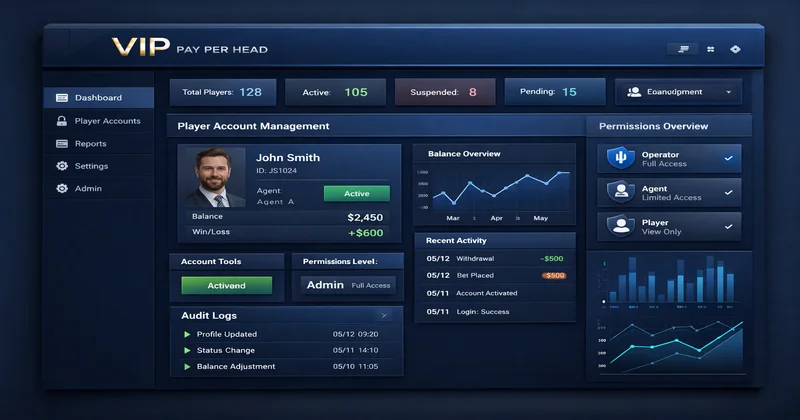
Core Structure of Pay Per Head Player Management
Pay Per Head player management defines how operators control, monitor, and adjust sportsbook accounts inside a professional platform. While the betting interface serves users, the backend account control system serves the operator.
This article explains how structured player account tools function inside a Pay Per Head platform. It focuses strictly on operational oversight, control clarity, and monitoring structure. It does not summarize the full Pay Per Head model. Instead, it answers one specific operational question:
What tools must exist inside a professional Pay Per Head player management system to ensure structured account control?
What Pay Per Head Player Management Actually Controls
At the operational level, Pay Per Head player management centralizes account oversight.
A structured system allows operators to:
- View all active player accounts
- Access detailed account profiles
- Monitor balance visibility
- Review activity history
- Adjust account status
These tools must exist inside a unified operator account control panel.
When account functions are scattered across multiple modules, workflow slows. Therefore, centralized sportsbook player control tools improve efficiency and reduce internal friction.
The dashboard should not require external spreadsheets or manual tracking. Instead, the pay per head account management interface must provide direct visibility.
Player Profile Structure Inside the Control Panel
A professional player profile management dashboard organizes account data into consistent fields.
Each profile should display:
- Account identification details
- Assigned agent, when applicable
- Account status level
- Activity timeline
- Current balance visibility
Clear segmentation reduces confusion. If profile data appears inconsistent, operators waste time verifying details.
Additionally, structured layouts improve speed. Operators should not navigate across multiple screens to view basic information. Instead, the sportsbook account monitoring system must centralize profile data.
This cluster does not analyze settlement logic. It focuses on structural visibility.
Account Status Management and Control Layers
Account status management is one of the most important functions inside Pay Per Head player management.
Operators must be able to:
- Activate accounts
- Suspend accounts
- Apply review flags
- Restore controlled access
Status changes must reflect instantly. If adjustments delay, oversight weakens.
Moreover, permission separation protects structural control. The operator retains full access, while lower tiers receive limited visibility.
For example, an agent may view assigned accounts only. Meanwhile, the operator sees system-wide status information inside the operator account control panel.
Clear control layers prevent overlap and reduce internal errors.
Balance Visibility and Tracking Oversight
Balance tracking is not about settlement formulas. It is about visibility.
A professional player balance tracking system should display:
- Current account balance
- Recent balance updates
- Time-stamped activity changes
- Adjustment logs
Operators must review account movements without switching tools. When balance visibility sits outside the main interface, response time slows.
Furthermore, structured tracking improves confidence. Operators can verify account status instantly inside the pay per head account management system.
Activity Monitoring and Account History Logs
Structured monitoring tools strengthen operational awareness.
A sportsbook account monitoring interface should record:
- Login timestamps
- Account adjustments
- Status modifications
- System activity records
This historical record supports internal review.
Additionally, visible logs protect operational integrity. When every action leaves a system trace, transparency improves.
However, this article does not cover advanced exposure modeling. It isolates account-level oversight only.
Why Structural Organization Improves Workflow
Workflow efficiency depends on panel organization.
When sportsbook player control tools group related functions together, operators move faster. For example, profile editing tools should sit near status controls. Reporting filters should not overlap with configuration panels.
Logical grouping reduces navigation errors.
Moreover, consistent structure shortens onboarding time. New operators adapt quickly when the dashboard layout remains predictable.
Professional Pay Per Head player management systems design for clarity first.
Monitoring Depth, Workflow Efficiency, and Permission Control
In Part 1, we examined the structural foundation of Pay Per Head player management. Now we move deeper into operational visibility and workflow control.
Account oversight does not end at profile viewing. Professional sportsbook operations require structured monitoring depth. Without it, operators rely on manual verification, which slows decision-making.
This section explains how monitoring tools, workflow logic, and permission layers strengthen operational control inside Pay Per Head platforms.
Monitoring Depth Inside Player Account Systems
Monitoring depth refers to how clearly an operator can review account activity.
A professional sportsbook account monitoring system should provide layered visibility. This includes:
- Real-time account status updates
- Timestamped account changes
- Activity history logs
- Balance movement visibility
- Adjustment trace records
However, this cluster does not cover exposure or settlement formulas. It focuses strictly on monitoring clarity.
When monitoring tools sit inside the pay per head account management interface, operators reduce external tracking. Centralized monitoring improves confidence.
Additionally, visibility should not require multiple panel switches. The operator account control panel must centralize account-level information in one structured view.
Real-Time vs Delayed Account Updates
Speed matters in Pay Per Head player management.
If status changes appear with delay, operators hesitate. They may double-check adjustments manually. That slows workflow.
Therefore, professional platforms ensure real-time synchronization between the player profile management dashboard and the account database.
For example, when an operator suspends an account, the change should reflect immediately inside the sportsbook player control tools. This immediate feedback confirms action accuracy.
Delayed systems increase friction.
Real-time confirmation strengthens control discipline.
Workflow Efficiency and Task Grouping
Workflow efficiency reduces operational strain.
Inside a professional operator account control panel, related tasks must sit close together. Profile editing, status management, and balance visibility should not require navigation across separate modules.
Grouped tools reduce repetitive movement.
Additionally, structured task grouping improves rhythm. When operators complete account updates within one controlled interface, daily operations become predictable. Consistency matters.
Moreover, predictable workflow reduces internal training time. New staff members adapt faster when navigation remains logical.
This efficiency strengthens long-term scalability.
Permission Layers Inside Player Account Control
Permission logic protects structural integrity.
Not every user should access full account controls. A professional Pay Per Head player management system defines access levels clearly.
For example:
- Operators retain full control.
- Mid-level users view limited accounts.
- Assigned agents see only related profiles.
Clear separation prevents overlap.
Furthermore, structured permission tiers reduce operational conflict. When visibility aligns with responsibility, workflow becomes cleaner.
This article does not discuss advanced agent engineering. It isolates dashboard-level permission control only.
Audit Trails and Action Logs
Operational transparency depends on visible logs.
A structured pay per head account management system records:
- Account status changes
- Balance adjustments
- Profile edits
- Permission modifications
Each action should create a timestamped record.
These logs protect accountability.
Additionally, audit trails reduce internal confusion. When operators review past adjustments, they avoid guesswork.
Professional sportsbook player control tools treat logs as a core feature, not an optional add-on.
Scalability Considerations in Account Management
As account volume grows, monitoring complexity increases.
Without structured oversight tools, operators lose clarity. However, a scalable Pay Per Head player management system maintains performance under expansion.
Scalable systems ensure:
- Fast profile loading
- Stable panel responsiveness
- Clean data segmentation
- Organized activity logs
If panel performance slows as accounts increase, operational strain follows.
Therefore, operators evaluating providers should examine dashboard responsiveness under volume.
Long-Term Stability, Evaluation Criteria, and Operational Readiness
In the previous sections, we examined the structure and monitoring depth of Pay Per Head player management tools. Now we focus on long-term operational stability and how operators should evaluate these tools before selecting a provider.
Account management is not a short-term feature. It directly impacts scalability, workflow rhythm, and control discipline over time.
This section explains how structured player account tools protect long-term sportsbook operations.
Why Long-Term Stability Depends on Account Structure
As a sportsbook grows, account volume increases. With growth comes complexity.
If the player profile management dashboard lacks structure, operators experience:
- Slower navigation
- Reduced clarity
- Increased manual verification
- Workflow friction
However, a stable Pay Per Head player management system maintains performance regardless of volume.
Stability means:
- Consistent panel responsiveness
- Fast profile loading
- Clean data segmentation
- Reliable status confirmation
Operators should not feel system strain as account numbers expand.
Scalable structure protects operational rhythm.
Centralized Oversight Reduces Fragmentation
Fragmented tools weaken control.
When player balance tracking, profile updates, and monitoring logs exist in separate modules, operators waste time navigating.
A professional operator account control panel centralizes these functions.
Centralization improves:
- Speed
- Clarity
- Accountability
- Internal coordination
Moreover, centralized tools reduce dependence on external tracking sheets. That eliminates manual error risk.
Pay Per Head player management must function as a unified control layer, not as scattered components.
Evaluation Checklist for Operators
Before committing to a provider, operators should request a live walkthrough of the player account tools.
During evaluation, review:
- Profile layout consistency
- Balance visibility clarity
- Status change confirmation speed
- Monitoring log depth
- Permission tier separation
Ask specific questions.
For example:
- Does every status adjustment create a log entry?
- Are balance updates reflected instantly?
- Can you filter activity history efficiently?
These practical checks reveal system maturity.
Operational Readiness and Daily Workflow Impact
Daily workflow depends on predictability.
When sportsbook player control tools remain consistent, operators develop routine discipline. Routine improves speed.
Additionally, consistent navigation reduces cognitive load. Operators focus on decisions instead of interface confusion.
Predictability also supports training.
New staff members learn faster when panel structure remains logical. Clear segmentation between profile tools and reporting filters shortens adaptation time.
Over months of operation, this efficiency compounds.
Structured Pay Per Head player management strengthens operational readiness.
Account Control and Internal Accountability
Internal accountability relies on visible records.
A professional pay per head account management system logs:
- Profile edits
- Status changes
- Balance adjustments
- Permission modifications
These logs create traceable action history.
Traceability reduces internal conflict.
Moreover, accountability improves trust within the operation. When adjustments are visible, disputes decrease.
However, this cluster does not cover financial settlement logic. It focuses strictly on account-level tracking.
Why This Matters for VIP Pay Per Head
At VIP Pay Per Head, structured player account tools support disciplined sportsbook operations. The platform centralizes profile control, balance visibility, and monitoring logs inside a unified operator account control panel.
Instead of relying on fragmented systems, operators manage account oversight through a clear, organized interface.
If you are evaluating Pay Per Head services, focus first on player account management maturity.
Request a live demonstration.
A professional Pay Per Head player management system improves daily efficiency, strengthens internal control, and protects long-term scalability.