
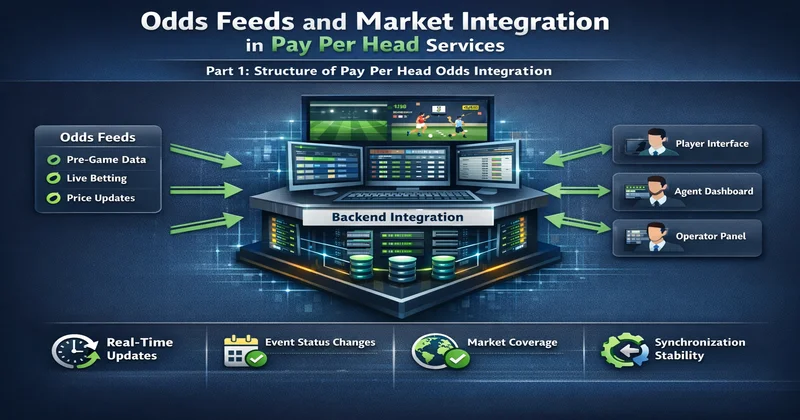
Structure of Pay Per Head Odds Integration
Pay Per Head odds integration determines how sportsbook platforms receive, synchronize, and display betting markets in real time. However, while front-end design attracts attention, backend feed structure defines operational stability.
Specifically, this article focuses strictly on how sportsbook odds feeds connect to Pay Per Head platforms and how operators should evaluate that integration. It does not summarize the entire Pay Per Head model. Instead, it explains one core issue:
How does odds integration impact operational stability inside a Pay Per Head sportsbook?
What Are Sportsbook Odds Feeds?
Sportsbook odds feeds deliver market data into the Pay Per Head system. These feeds include, for example:
- Pre-game markets
- Live betting markets
- Price updates
- Event status changes
- Market opening and closing triggers
The sportsbook data feed connects directly to the platform’s backend. Therefore, integration quality determines how fast real-time odds updates appear inside the system.
For instance, if synchronization fails, the platform experiences:
- Delayed line updates
- Market inconsistencies
- Visibility lag
Therefore, Pay Per Head odds integration must remain stable at all times.
Feed Source Structure and Data Routing
Professional platforms connect to structured sportsbook odds feeds through secure routing systems. These routing systems manage how market feed synchronization occurs inside the backend.
The routing layer determines:
- Update frequency
- Data filtering
- Market validation
- Status confirmation
Operators do not control routing directly. Still, they depend on its reliability.
Consequently, if routing creates delay, live odds management becomes inconsistent.
A stable routing structure ensures that betting market integration remains synchronized across all interface layers.
Real-Time Odds Updates and Platform Responsiveness
Real-time odds updates define operator confidence.
When sportsbook odds feeds push updates into the platform, the backend must process those updates immediately. Otherwise, delayed refresh cycles create uncertainty.
A strong Pay Per Head odds integration system ensures:
- Immediate market refresh
- Accurate price reflection
- Stable update sequencing
- Event-level synchronization
For instance, if a market closes, the system must reflect that status instantly. Delayed closure signals increase operational risk.
Therefore, real-time update stability matters more than visual layout.
Market Coverage Structure and Integration Depth
Integration depth determines how many markets the system supports and how they remain organized.
A professional sportsbook data feed should provide:
- Mainline markets
- Alternate lines
- Totals
- Spread variations
- In-play segments
However, this cluster does not analyze line movement strategy. Instead, it focuses only on integration structure.
Market coverage structure must align with platform segmentation rules.
In practice, if market layers overload the interface, navigation weakens. Therefore, Pay Per Head odds integration must balance coverage with clarity.
Synchronization Across System Layers
Market feed synchronization must occur across:
- Player interface
- Agent interface
- Operator control panel
If one layer updates while another lags, operational clarity declines.
As a result, synchronization consistency ensures that all system views reflect identical market status.
Professional Pay Per Head odds integration platforms prioritize synchronized refresh cycles.
To verify this, operators evaluating providers should confirm:
- How often feeds update
- Whether live odds management remains stable
- If system latency appears during heavy activity
Consistency across layers signals structural maturity.
Why Integration Stability Matters Early
Operators often focus on front-end appearance. Nevertheless, backend integration defines reliability.
If sportsbook odds feeds lack stability, long-term scalability suffers.
Stable Pay Per Head odds integration supports:
- Predictable market availability
- Organized event coverage
- Real-time system responsiveness
- Reduced operational friction
Latency Testing, Live Market Stability, and Feed Performance Control
We explained the structural foundation of Pay Per Head odds integration. Next, we examine how operators should evaluate feed latency, live market stability, and performance consistency inside a Pay Per Head platform.
Odds integration is not only about connection. It is about responsiveness under real conditions. A feed may function during low volume. In contrast, true stability appears during peak activity.
This section explains how to assess integration maturity.
Understanding Feed Latency in Real-Time Systems
Latency measures how long it takes for sportsbook odds feeds to reflect updates inside the platform.
Ideally, in a stable system:
- Price changes update instantly
- Market status shifts reflect immediately
- Event transitions appear without delay
If latency increases, operators may see outdated markets.
For example, during live events, rapid scoring changes trigger price adjustments. If real-time odds updates lag, the interface shows stale values.
For that reason, operators must test latency during demo sessions.
Ask providers:
- How frequently does the sportsbook data feed refresh?
- Does update speed remain consistent during peak activity?
- Are refresh cycles synchronized across all panels?
Reliable Pay Per Head odds integration maintains uniform update timing.
Live Market Management and Stability Control
Live betting environments create constant market movement. Prices change rapidly. Markets open and close frequently.
Live odds management depends on:
- Continuous market feed synchronization
- Immediate price reflection
- Stable event state updates
- Accurate market suspension signals
Consequently, if integration becomes unstable, live markets may:
- Display delayed prices
- Remain open when they should close
- Refresh inconsistently
Professional betting market integration systems prioritize suspension accuracy. Market closure events must process immediately.
Operators should verify how the platform handles:
- Rapid event updates
- Simultaneous market changes
- High-frequency refresh sequences
Consistency under pressure signals backend strength.
Market Validation and Data Integrity
Integration is not only about speed. Additionally, it is also about validation.
A professional Pay Per Head odds integration system must validate incoming feed data before displaying it.
Validation includes:
- Confirming event identity
- Checking market availability
- Verifying price formatting
- Aligning market hierarchy
Otherwise, feed errors may propagate through the system.
For example, if an event ID mismatch occurs, incorrect markets could appear under the wrong event category.
Stable sportsbook odds feeds include structured validation layers to prevent such errors.
Operators should confirm whether the provider uses internal data verification processes.
Handling High Volume and Peak Traffic
Market performance must remain stable during peak activity.
Peak traffic may occur during:
- Major sports events
- Simultaneous game starts
- High live activity periods
As a result, sportsbook data feed processing load increases.
A mature Pay Per Head odds integration framework ensures:
- Consistent refresh intervals
- Stable panel performance
- No interface freezing
- Predictable synchronization cycles
Operators should test peak simulation scenarios during demos. Request live event walkthroughs and monitor refresh stability.
Stable behavior under pressure reflects system maturity.
Feed Redundancy and Backup Stability
Feed redundancy protects continuity.
Professional sportsbook odds feeds often include backup routing layers. If one data path fails, the system reroutes automatically.
Operators may not see this process directly. Still, redundancy ensures uninterrupted market availability.
Stable betting market integration requires:
- Backup feed support
- Automatic rerouting
- Continuous monitoring
- Real-time failure detection
Without redundancy, a single feed interruption may disrupt the entire sportsbook interface.
Therefore, integration evaluation should include questions about feed failover systems.
Synchronization Between Pre-Game and Live Markets
Pre-game and live markets require coordinated updates.
If pre-game odds update smoothly but live markets lag, integration depth becomes uneven.
A stable Pay Per Head odds integration system ensures:
- Unified refresh logic
- Consistent market hierarchy
- Coordinated update cycles
- Clear status alignment
Operators should verify whether both pre-game and live segments share identical synchronization standards.
Consistency across market types strengthens reliability.
Long-Term Stability, Provider Evaluation, and Operational Scalability
Odds integration is not a surface feature. It is backend infrastructure. By contrast, when integration is strong, market delivery remains stable. When integration is weak, instability appears gradually.
This section explains how integration quality affects scalability and why feed maturity should influence provider selection.
Why Long-Term Integration Discipline Matters
Odds feeds operate continuously. Unlike static platform features, sportsbook odds feeds process updates throughout the day.
Because of this, integration discipline determines:
- Market availability consistency
- Update accuracy
- Event synchronization reliability
- Live odds management stability
If integration lacks discipline, small inconsistencies appear first. Over time, those inconsistencies create operational friction.
For example, minor delays during peak events may not seem critical initially. However, repeated delays reduce confidence in market synchronization.
Therefore, Pay Per Head odds integration must remain stable across daily cycles, not only during demos.
Evaluating Feed Stability Over Time
Instead, request operators should not evaluate integration based on a single test.
Instead, request:
- Live event demonstrations
- Multi-event refresh testing
- Pre-game to live transition checks
- Repeated market refresh sequences
Stable betting market integration maintains:
- Identical refresh timing
- Clean event alignment
- Predictable market closure behavior
- Organized coverage structure
If update timing fluctuates or panel refresh feels inconsistent, integration maturity may be limited.
Ultimately, long-term stability matters more than visual design.
Integration Scalability and Market Expansion
As sportsbooks grow, market coverage expands. New leagues, event types, and live segments increase feed volume.
A mature sportsbook data feed integration must scale without performance degradation.
Scalability includes:
- Stable refresh speed under higher load
- Organized market categorization
- Consistent synchronization logic
- Controlled latency behavior
However, if expansion causes slower updates or delayed market openings, integration architecture may lack depth.
Professional Pay Per Head odds integration supports growth without sacrificing update stability.
Operational Impact of Inconsistent Integration
When odds feed stability weakens, operational friction increases.
Inconsistent integration may lead to:
- Delayed event status updates
- Unpredictable market refresh cycles
- Temporary market display mismatches
- Confusion between interface layers
Over time, even if these issues appear small, they reduce structural clarity.
Therefore, operators must treat sportsbook odds feeds as operational infrastructure, not optional enhancements.
Stable integration reduces internal monitoring strain and improves daily rhythm.
Provider Evaluation Criteria for Odds Integration
During platform selection, operators should focus on technical discipline, not marketing language.
Ask providers:
- How is market feed synchronization monitored internally?
- What redundancy layers protect sportsbook odds feeds?
- How does the system handle peak live activity?
- Are refresh cycles consistent across all interface layers?
- How frequently are feed health checks performed?
These questions reveal backend maturity.
Moreover, request confirmation that real-time odds updates remain stable during simultaneous event processing.
Integration strength becomes visible during pressure testing.
Structured Market Organization and Interface Alignment
Integration maturity also appears in how markets remain organized.
A professional betting market integration system must align:
- Event hierarchy
- Market segmentation
- Live and pre-game categories
- Status indicators
If structure becomes disorganized, navigation slows.
Therefore, Pay Per Head odds integration must ensure that:
- Market categories remain stable
- Update order remains predictable
- Event transitions synchronize across panels
Clean organization supports operational confidence.
Why This Matters for VIP Pay Per Head
At VIP Pay Per Head, structured odds feed integration supports disciplined market delivery. The platform centralizes sportsbook odds feeds inside a controlled backend environment designed for stability and synchronized updates.
Operators evaluating Pay Per Head providers should prioritize integration maturity before reviewing secondary features.
For example, request a structured walkthrough of:
- Real-time odds updates
- Live market management
- Synchronization across panels
- Peak event refresh performance
Strong Pay Per Head odds integration improves stability, protects scalability, and strengthens operational confidence.